
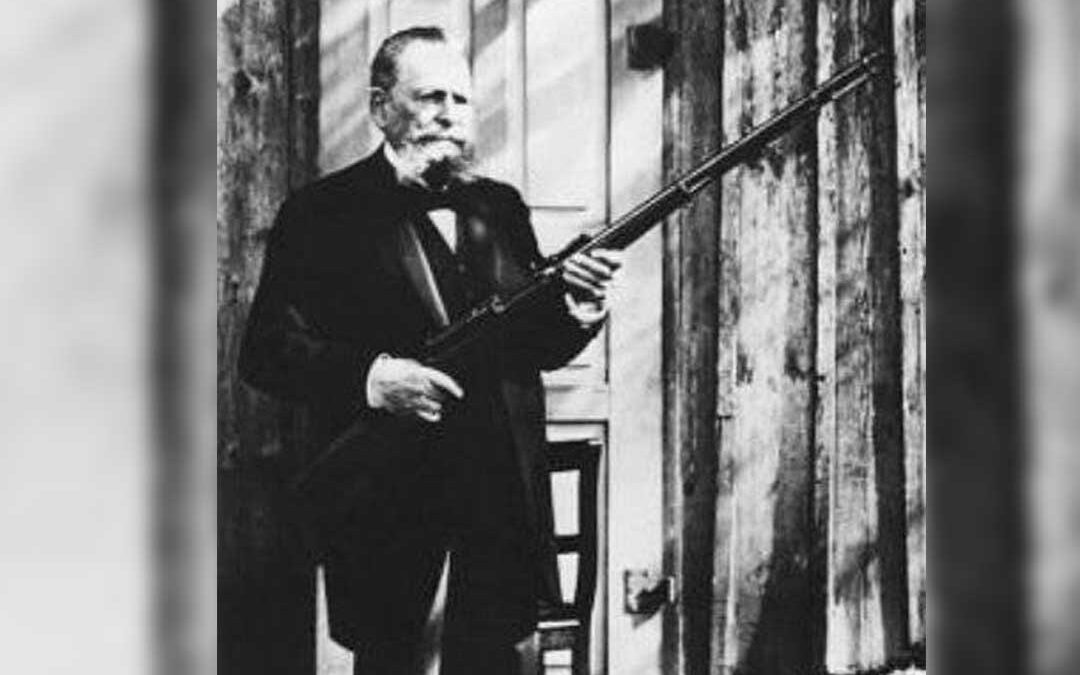
His rifles armed world powers in titanic wars, and hunters in the greatest game fields on Earth.
The spoor, braided at first, was unraveling. “Ready to bed,” John mouthed the words. Short yards ahead, a patch of dried mud came to eye—two feet off the ground. Hand-signals split the trackers.
Probing carefully, we located seven bulls. One lay to the west. “Dagga boy.” Again, silent words. I crept windward, over a fold in the earth. This buffalo wore a cloak of fresh mud. It glinted above a dark delta, visible through a cleft in the grass. Bead a-quiver on that pie-slice of shoulder, I pressed the trigger.
The strike was lost in the bull’s roar. Up instantly and spinning, he caught the follow-up solid on a horn-tip as it drove to the scapula. The Mauser’s bolt clattered again, the sight coming out of recoil and my third missile leaving as the bull emerged from the dust. It broke his neck, felling him.
I thumbed fresh “nine-threes” into the magazine, the bolt slicking up the top-most.
In Africa these days, I’ve come to use only open-sighted Mausers. A nod to tradition. No rifle has earned more hunting plaudits there—or more profoundly influenced the course of nations.
Peter Paul Mauser’s best-known rifles didn’t appear until he’d failed with others and grown older than many men of his generation would live. But he started early.
Born June 27, 1838, Paul would be likened to his American contemporary, John Browning. Both men were gifted gunsmiths, able to “think” ideas into prototype parts, then marry them into a functioning whole. While comparisons 150 years after the zeniths of these careers are pointless, Mauser’s ingenuity and mechanical genius surely established him as Europe’s pre-eminent firearms designer of his century.

This photo of a Mauser ’98 action shows its signature non-rotating extractor, flag safety and boxed bolt release – also slot and thumb cut for loading with a stripper clip.
Paul’s father, Franz Andreas von Mauser, had come to the quiet Swabian village of Oberndorf on the Neckar River in Wuerttemberg with the military “Ouvrier Compagnie.” After his discharge, he stayed to work at the Wuerttemberg Royal Armory. He married an Oberndorf lass in 1819. Franz’s salary barely gave the family a middle-class income. To generate more, he loaded ammunition at home. Paul and his four brothers were well educated for the times and received special instruction in drawing and geometry. All were expected to follow their father’s career. Paul apprenticed at the factory from age 14. With Wilhelm, four years his senior, he showed exceptional promise.
In 1859, Paul was called into military service and sent to Ludwigsburg Arsenal as an artilleryman. As the story goes, his requests for leave were often denied, local officers fearful Oberndorf would snatch him back. Meanwhile, he was trained in special work not available to ordinary inductees. He returned to Oberndorf at year’s end. There he and Wilhelm crafted a breech-loading cannon of such merit, the King of Wuerttemburg paid them for a prototype.
But Paul Mauser’s main interest was small arms.
Almost anybody could have developed a rifle action that locked like a door-latch. Indeed, some did before Paul seized upon the idea. One of them was Johann Nikolaus von Dreyse, who developed the Dreyse needle gun, German’s primary shoulder arm in the Franco-Prussian War. Its long “firing needle” pierced the powder charge of a unique sabot cartridge to ignite priming compound in the bullet’s base. Paul had been enchanted by this single-shot rifle early on but recognized weaknesses too.
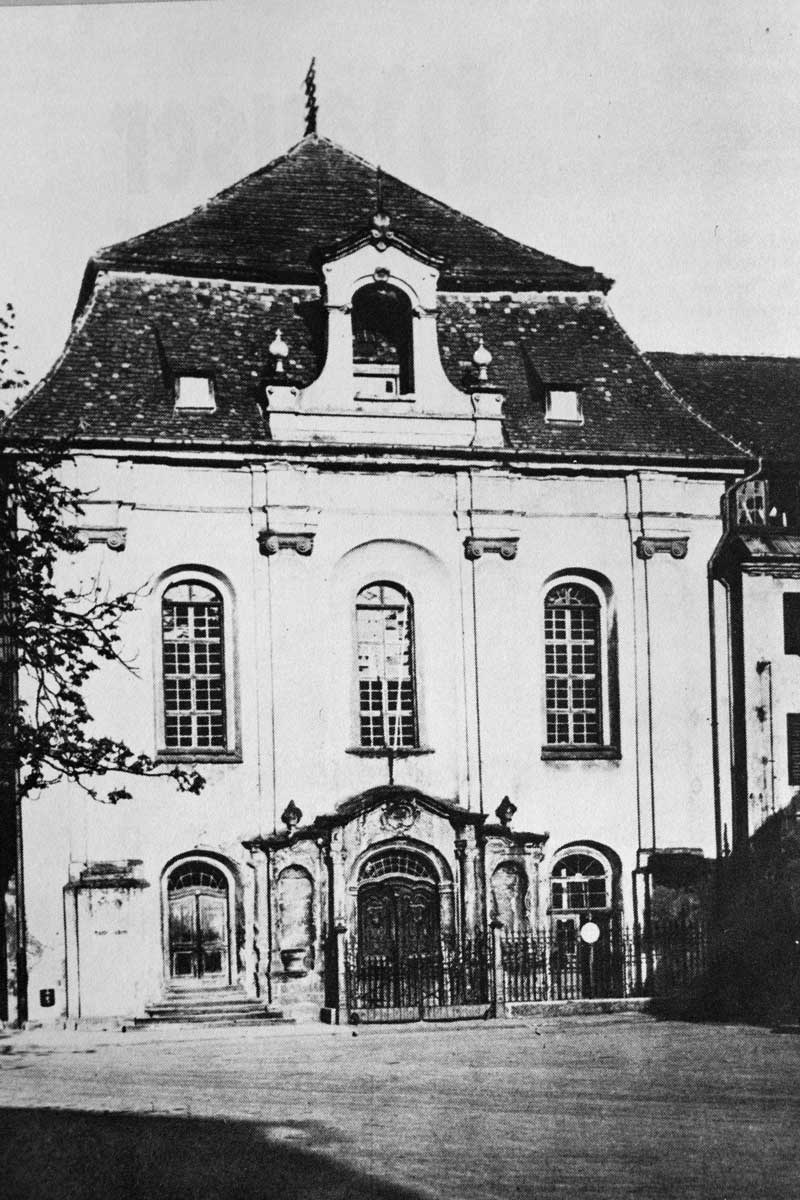
Once an Augustinian Cloister, this building became the Weurttenberg Royal Armory in 1811. Paul and Wilhelm bought it in 1874 to hike Mauser’s production capacity. Paul made his home there.
While working at the Wuerttemberg Royal Armory, Paul gave the Dreyse a self-cocking bolt and a firing pin that struck a rear-primed cartridge. Arguably, it was a new rifle that shared a bolt handle with the Dreyse. He and Wilhelm, who’d helped in the project, pitched the rifle to the Wuerttemberg War Ministry as an infantry arm. The Ministry demurred, satisfied with its muzzleloading Minie rifle. The Prussians also shook their heads: The Dreyse was good enough. Recovering from conflict in 1866, Austria was eager to improve its infantry arms. Alas, it had just adopted the Waenzl cartridge conversion for muzzleloaders.
At the Austrian War Ministry, as luck would have it, the Mausers’ Dreyse-based rifle caught the eye of Samuel Norris, an American in Europe as an agent for E. Remington & Sons. (Franz Mauser, one of Paul’s older brothers, who’d emigrated to the U.S. in 1853, also worked for Remington.). Norris’ hosts assured him that were it not for the Waenzl commitment, Austria would have awarded Paul and Wilhelm a contract. So inspired, Norris traveled from Vienna to Oberndorf and urged Paul and Wilhelm to partner with him in converting the French Chassepot needle gun to accept metallic cartridges. The rifles would be produced in Liège, Belgium, and sold to the French. Keen to salvage a future for their efforts, the brothers moved to Liège in September 1867 and tooled up. But when Norris failed to interest France in a better Chassepot, he bailed out of their agreement. (Norris then filed to patent the Mausers’ work in the U.S! On June 2, 1868, a needle gun conversion became the first patented rifle bearing the Mauser name.)
Lacking funds to continue with the Chassepot project, Paul returned to Oberndorf in December 1869. Wilhelm followed five months later. They set up tooling in the home of Paul’s father-in-law, went back to work refining their Dreyse-based rifle and cast about for buyers. In Munich, Wilhelm brought it to the Bavarian War Ministry. Alas, Bavaria had already settled on the Werder breech-loader.

Paul Mauser built safety into his rifles. This 1898 bolt shows generous ports on the bolt belly, to shunt powder gas downward in the event of a blown primer or case failure.
Meanwhile, however, the Royal Prussian Military Shooting School had been testing a Mauser it had acquired from Norris. Impressed, ordnance officers asked the brothers for modifications to satisfy requirements of the Royal Prussian Rifle Testing Commission. Wilhelm made the trip to Spandau near Berlin. On December 2, 1871, the Mauser rifle was chosen to replace the Prussian needle gun—provided its safety could be tweaked to satisfy the Commission. Paul made that change, and by February 14, 1872, the rifle was officially designated Infantry Rifle, Model 71. It fired an 11mm (43 caliber) blackpowder cartridge that sent 385-grain bullets at 1,400 fps.
If Paul and Wilhelm expected money to rain from the rafters, they were soon set straight. Rather than contract with the brothers to produce the Model 71, Prussia preferred that it come from government arsenals and/or large factories like that of Austrian Arms Co. in Steyr. Instead of receiving 60,000 Talers for Prussia’s rights to the rifle, the Mausers would get 8,000. (A Taler was the equivalent of three Marks.) Their consolation prize was an order for 3,000 rifle sights. They grabbed it. Wilhelm’s business acumen continued to complement Paul’s wizardry at the bench. A small factory for the sight project sprang up in the Xaver Jauch house in Oberndorf. An order for sights by the Bavarian Rifle Factory at Amberg then prompted the Mausers to build another factory above the Neckar River Valley the “Upper Works.” By the end of 1872, the Oberndorf trade register listed Gebrueder Wilhelm and Paul Mauser: Brothers Wilhelm and Paul Mauser. Once mechanics, they’d become managers, with dozens of workers on the payroll.
The need for even more space became urgent when Wuerttemberg negotiated with the Mausers to furnish 100,000 Model 71 rifles to arm its 13th Army Corps. The contract hinged on the purchase of the Wuerttemburg Royal Armory. The brothers put 200,000 Marks into a partnership with the Wuerttemberg Vereinsbank of Stuttgart, which contributed a million Marks toward the purchase. The Upper Works was included in this partnership; so too the original Oberndorf factory (the Lower Works). The Royal Armory was called the Central Works. On February 5, 1874, these operations became Mauser Bros. and Co. When an August fire at the Upper Works choked output, the Mausers rebuilt the charred section in eight weeks.
The last of the 100,000 Model 71 rifles for Wuerttemberg were delivered six months before the contract expired in 1878. Then China ordered 26,000 more. To keep manufacture of the 71 from foreign competitors, the Prussian War Department prohibited the Mauser brothers from seeking patents on the rifle’s features outside Germany. In March 1876, the Kaiser paid 12,000 Marks to the Mausers for use of the Model 71 design.
Orders for rifles subsided in the late 1870s, during which Paul developed a revolver and a single-shot pistol. The revolver was produced in quantity for Bavaria and Wuerttemberg. In 1881 a rifle contract from Serbia brought the Mausers much-needed cash. But Wilhelm’s health, impaired by a relentless work schedule and strenuous travels, deteriorated. He went to Bad Kreuznach to recuperate but did not. He died in January 1882, not yet 50 years old.

The 375 H&H begs a Magnum Mauser action. The bolt on this one slicks those long, tapered rounds from follower to chamber, and as smoothly extracts. Note the QD scope base, cocking-piece sight.
The Mauser firm became a stock company April 1, 1884, under the name Waffenfabrik Mauser (Mausers Arms Co.) The Wuerttemberg Vereinsbank appointed a business administrator; Paul remained plant manager and technical chief. By then the Mauser complex had an Outer Works, which grew in 1887 to fulfill a Turkish contract. December 28 of that year, Ludwig Loewe & Co. of Berlin bought controlling shares of the company—also Paul Mauser’s. Loewe would later acquire over half the stock of Fabrique Nationale d’Arme de Guerre (FN), founded in 1889 at Herstal, near Liège, to produce Mauser rifles for the Belgian government.
By the early 1880s, it was clear wars would soon be fought with repeating rifles. So Paul added a nine-shot tube magazine in the forend of his Model 71. The 71/84 proved a reliable arm, but it was crude compared to later Mausers and its 11mm bullet fell steeply. As late as 1967, when American troops were toting M-16s, you could still buy Mauser 71/84 rifles—for about $15.
Paul Mauser’s Model of 1889 was his first successful rifle for smokeless ammunition. It boasted a one-piece bolt with two front lugs, and a magazine charged by stripper clip. Turkish 1890 and Argentine 1891 Mausers were similar. All chambered the 7.65×53 Mauser cartridge. Notably, they shared a narrow, failure-prone extractor, and could fire with the bolt out of battery.
During the 1890s Paul Mauser would work quietly but diligently on a series of bolt-action rifles. On November 7, 1896, Deusche Waffen-und Munitionsfabriken A-G (German Arms and Ammunition Co., Inc.), or DWM, was formed by the merger of Deutsche Metallpatronenfabrik A-G (German Metallic Cartridge Co., Inc.) with Ludwig Loewe & Co., also Rheinisch-Westfaelischen Powder Co. and Rottweil-Hamburg Powder Co. As Loewe owned all Mauser stock and most of FN’s, these two firms were pulled into the DWM fold.
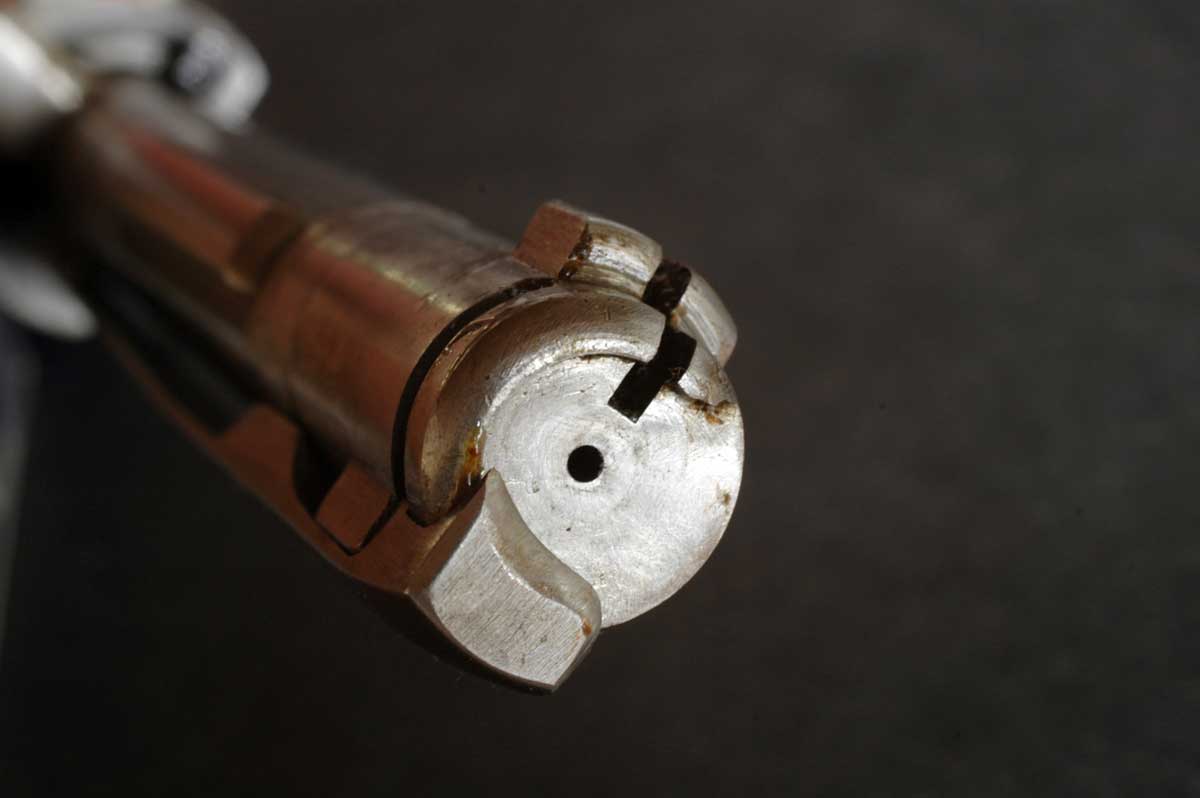
Paul designed the beefy Mauser claw to control feeding, eliminate double-loading and jams in the heat of battle. Hunters favor it too. The ejector rides in the slot opposite.
Paul’s latest bolt-actions of that decade had features that would appeal to riflemen a century on. In the Model 1892 Mauser, he introduced the long, non-rotating extractor now widely hailed as the most reliable claw ever. Attached to the bolt body with a collar, it required the rising case head to slide up into the claw for a positive grip before the bullet aligned with the barrel. The 1892 bolt cleared the breech if, in the press of battle, a rifleman short-cycled. The stout claw engaged a big section of case head to haul reluctant hulls from hot, dirty chambers.
The Model 1892’s fixed magazine held a single vertical stack and protruded from the rifle’s belly. A sear pin fitted up with a notch in the bolt to prevent firing if the bolt wasn’t locked. An anti-bind rib on the left-hand lug race mated with a slot in that lug.
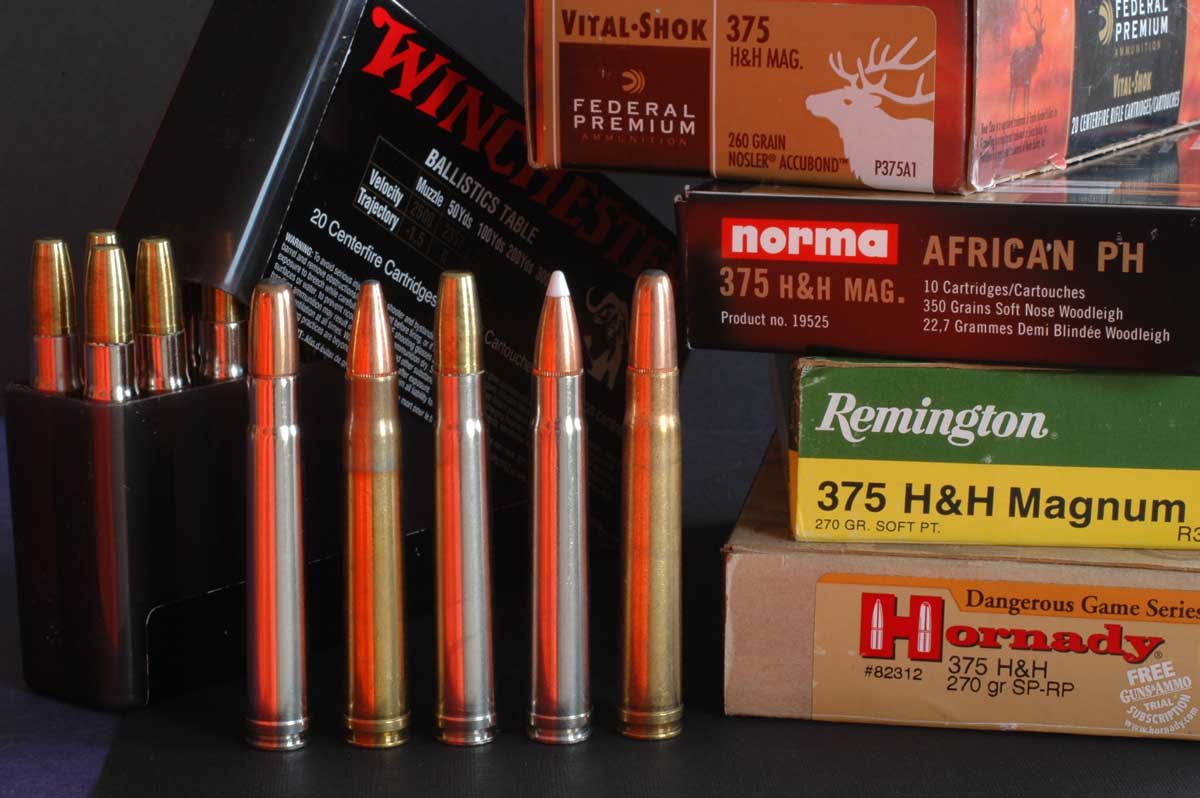
Military Mauser actions weren’t made for the popular 375 H&H. But Magnum Mausers handle it and the 404 Jeffery, even cartridges as burly as the 416 Rigby and 505 Gibbs.
The ’92 had served barely a year in uniform before Paul gave it a flush, fixed magazine holding a staggered column. The resulting ’93 “Spanish Mauser” was a hit and adopted by armies world-wide. Its flat-belly receiver, with integral recoil lug, was machined from a steel forging. A camming surface in the bridge engaged the bolt handle base to aid primary extraction. The flag safety pivoted atop the bolt sleeve. Thumbed to the right, it locked bolt and striker. Vertical, it permitted cycling only. To the left was “fire.” Bolt handles on most 1893 and 1895 rifles were straight. Turned-down bolt handles appeared on carbines.
With these changes came a new smokeless round: the 7×57 Mauser. Deadly during the Spanish-American War, it would influence U.S. cartridge design. As the British 275 Rigby, it became a favorite “smallbore” hunting round in Africa.
Mauser carbines bought by Sweden in 1894 inspired Carl Gustaf’s arsenal Stads Gevarsfaktori, in Eskiltuna, to build more. These fired the 6.5×55 Swedish round.
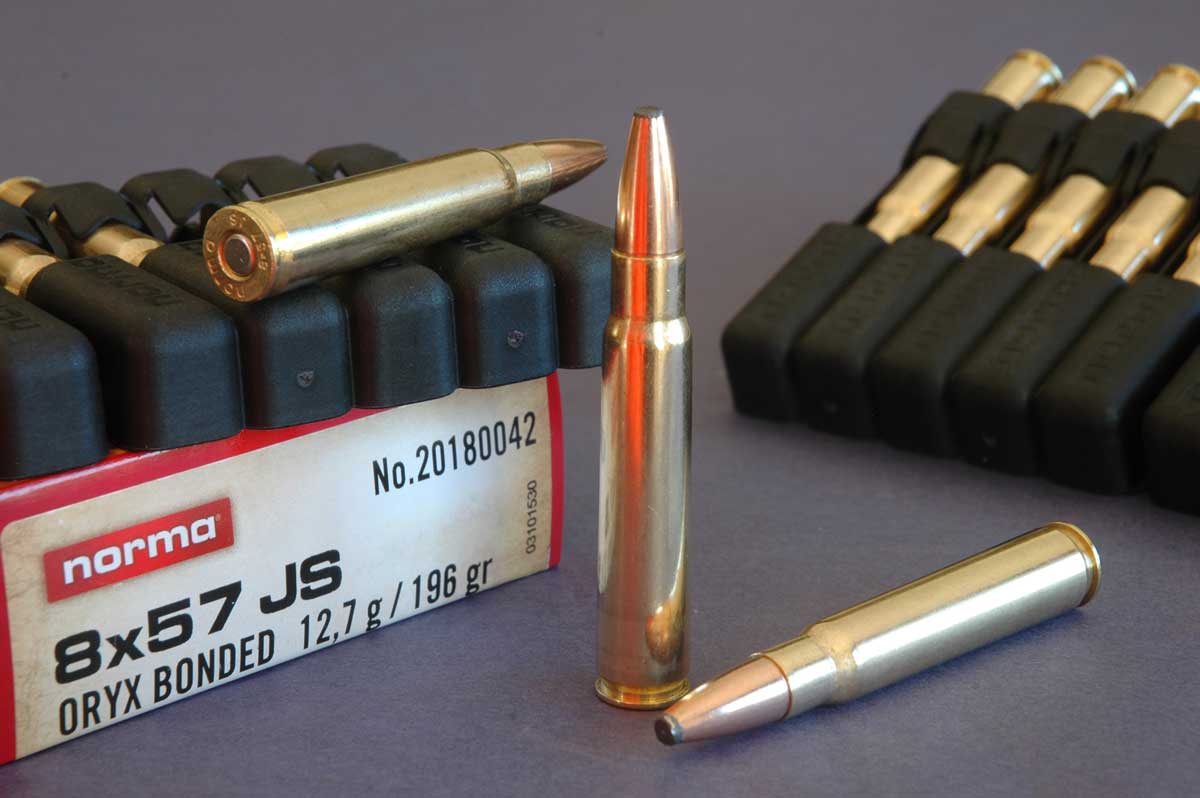
The ’98 Mauser was first chambered to 7.9x57I (or J) with a .318-inch bullet. Its more potent successor, the 8x57IS, fired a pointed .323-inch bullet faster. The U.S. updated the 30-03 cartridge with a lighter, faster, 30-06 load.
Improvements on the 1893 Mauser action resulted in the Model of 1898, adopted by the German Army April 5 that year. It was barreled to an 8mm smokeless round introduced for the 1888 Commission rifle (not a Mauser). Known as the 7.9×57 or 7.9x57I (common use of J for I is incorrect), it sent a 227-grain .318-inch bullet at 2,100 fps. The 1898 action cocked on opening. The Boxer Rebellion drew this Mauser into military service that would stretch through two world wars. In 1935 the Gewehr 98 gave way to the Karabiner 98 (KAR.98 or K98). The action was essentially unchanged. Exported to many nations, the ’98 was produced in many more. Great Britain, France, Russia and the U.S. designed their own battle rifles; none would cycle more reliably, endure abuse more ably or shoot more accurately than the Gewehr 98.
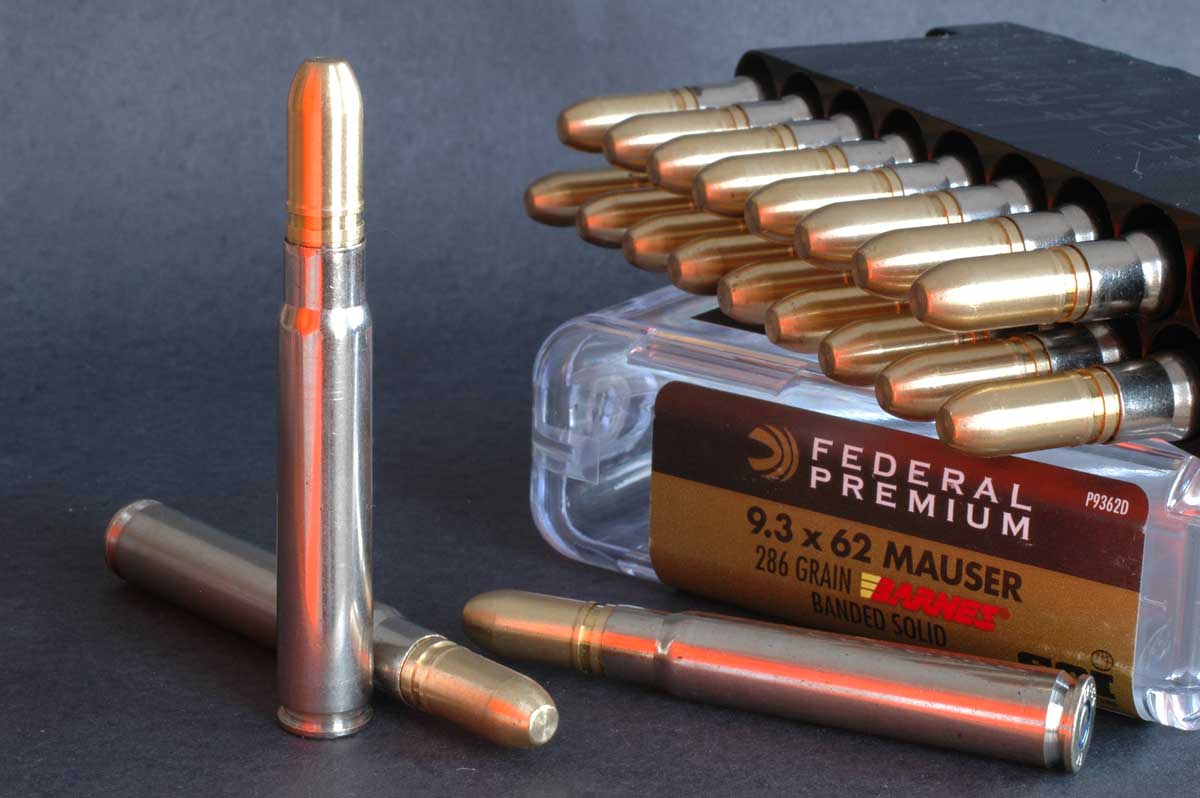
Otto Bock of Berlin developed the 9.3×62 cartridge in 1905. It became a favored big game round in German-controlled Southwest Africa (now Namibia) and fits in standard Mauser actions.
In 1905, Germany introduced a more powerful cartridge for the 1898. The 8×57 with 154-grain pointed .323-inch bullet at 2,870 fps generated breech pressure of nearly 50,000 psi, 10 percent higher than that of the 7.9x57I. Officially, the 8×57 was designated 7.9x57IS and 8x57IS. It had such great reach, the Lange Visier rear sight with shallow V notch could be adjusted for point-on aim to 2,000 yards.
In 1918, the Treaty of Versailles prohibited use of military ammunition by Germans. The 8x60S (.323-inch bullet) was a logical sequel to the outlawed 8x57IS. Re-chambering made 1898 infantry rifles into legal hunting arms. A less frisky 8×60 followed, for ’98s barreled to the original 7.9×57 (.318-inch) cartridge.
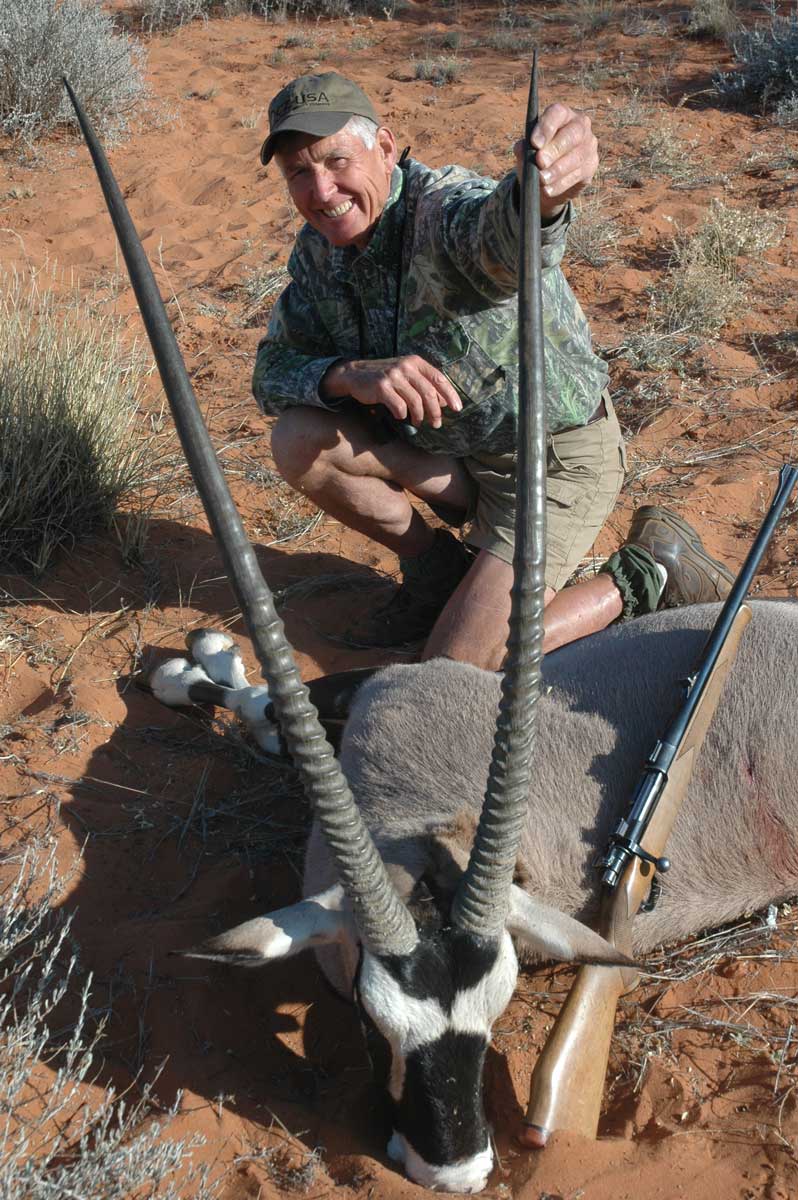
A 140-yard shot with an open-sighted Mauser in 9.3×62 took this fine gemsbok. Proven in battle, the Mauser ’98 action is as durable and reliable in tough hunting conditions.
Receiver rings of most 1898 military rifles are 1.41-inch in diameter. Early ’98 carbines such as the 98a, had 1.30-inch receiver rings. Later, Czech 33/40s also had this “small-ring” receiver. Throughout its military life, the 1898 receiver was made of tough, low-carbon steel case-hardened or carburized for a hard finish. During the final, frantic years of WWII, receiver hardness varied. Shooters planning a custom rifle on a military Mauser action have long been told to choose a large-ring 1898 produced between 1920 and 1943. A Mauser stamp is a bonus. Other favored options: DWM, FN and Brno (VZ-24).
In the ashes of WWII, the Mauser Waffenfabrik (arms factory) was renamed Werke (works), and its marketing re-directed to hunters. Mauser engaged U.S. agent A.F. Stoeger, Inc. of New York, to sell the brand stateside. Stoeger assigned numbers to Mauser actions. By the late 1930s, the line comprised 20 configurations in four lengths: magnum, standard, intermediate and short, or kurz. The kurz, with a small receiver ring, was factory barreled for only three cartridges: 6.5×50, 8×51 and 250 Savage.
Paul Mauser died May 29, 1914, just before his rifle muddied and bloodied itself in the trenches of France. An obituary appeared in Arms and Explosives magazine in London, in July:
Paul Mauser has finished making rifles. He caught a chill whilst testing [firearms]. A brief illness terminated his dreams of migrating to a country villa fast nearing completion. Like all men whose chief delight is in their business he postponed his well-earned retirement, knowing that … satisfaction for him lay in the fashioning of [superior] mechanisms…. [So] his rifles could be made by the hundred thousand without those disastrous delays [caused by] unexpected defect. He not only worked by day, but he took his rifles to bed with him, and was often rewarded by inspirations which refused to come at other times.
In character he was a simple-minded man, believing that everybody he met was a good fellow like himself. If events proved differently, he regretted the mischance, but was not soured by [it]. Like most great inventors, he took more interest in things than in people. The magnificent organization which grew around his labours was inspired by him, but not of his building…. Nobody can say that Mauser was any the worse off as a consequence. He lived his own life, unperturbed by the necessity to study financial problems…. Great as Mauser’s talents undoubtedly were, there have been other men … great in embryo who have failed because [resources were] not forthcoming. Mauser’s brother possessed business instincts of a high order, but fate ruled that he should die … when his services were most required. Mauser was of course not a poor man … but he will not leave a fortune like Alfred Nobel. Even the inventor of dynamite made more money out of oil than explosives. The reward of worldly fame has unstintingly fallen upon Mauser. All rifles are Mauser rifles, all the Mauser factories bear his name. He has been decorated more profusely than perhaps any other inventor….
To anybody who has closely followed the history of the English arms trade, poignant regret must be ever felt that a Mauser factory was not installed in this country twenty years ago. An energetic effort was certainly made to teach our War Office what a good rifle really was like, and how feeble was the British attempt to realize it…. England’s reputation and influence would have secured orders from many countries which, for political or other reasons, were not anxious to deal with Germany…. The English taxpayer would have saved many pounds, and England’s industrial reputation would have been saved the many slurs which have been cast upon it through its inability to cater for the world’s requirements in military rifles…. How fortunate that Maxim chose England for his home. If the same brilliant idea had occurred to Mauser, how happy we should all have been.
Mausers Afield
Early in the 20th century, Mauser sporting rifles were the best you could get. But Mauser actions weren’t available to all in the British gun trade. In 1900, Mauser chose John Rigby & Co. of London as its agent. Surely Rigby saw big-cartridge possibilities in Mauser’s ’98 action, with its cock-on-opening bolt, short lock time, third lug and twin gas vents. In fact, Rigby may well have influenced Mauser’s decision to build a magnum-length action. In 1911, the introduction of Rigby’s .416 in Mauser rifles put repeaters on equal footing with popular double rifles. Its 410-grain bullets carried 5,100 foot-pounds of muzzle energy! Rigby knew the value of its relationship—and refused to sell Magnum Mauser actions to its competition.

The square bridge on this beautiful Magnum Mauser action shows the fine machining and finish that endear Mausers to enthusiasts. The rifle here is by Rigby in .416.
After Rigby’s monopoly on Mausers ended in 1912, other British gun-makers built rifles on them. Westley Richards barreled Mausers to its .318 and .425 cartridges. W.J. Jeffery used the M98 for its .333 and .404. I’ve hunted with a Holland & Holland .375 on Magnum Mauser metal. Even the 505 Gibbs will fit in that action. But not all African-bound Mauser sporters hurled big bullets. W.D.M. Bell killed elephants with Mausers in .275 and reportedly owned six, as well as one in .416, another in 22 Savage Hi-Power. In India, the great tiger hunter Jim Corbett used a Rigby Mauser in .275.
Stateside between world wars, even pedestrian sporting rifles on commercial Mauser actions from Oberndorf came dear. Two years after the 1937 debut of Winchester’s Model 70 at $61, Mauser sporters cost three times as much! Affordable rifles with commercial ’98 actions followed. The Whitworth and Browning High-Power rifle are two fine examples. Both were dropped in favor of actions cheaper to produce.